
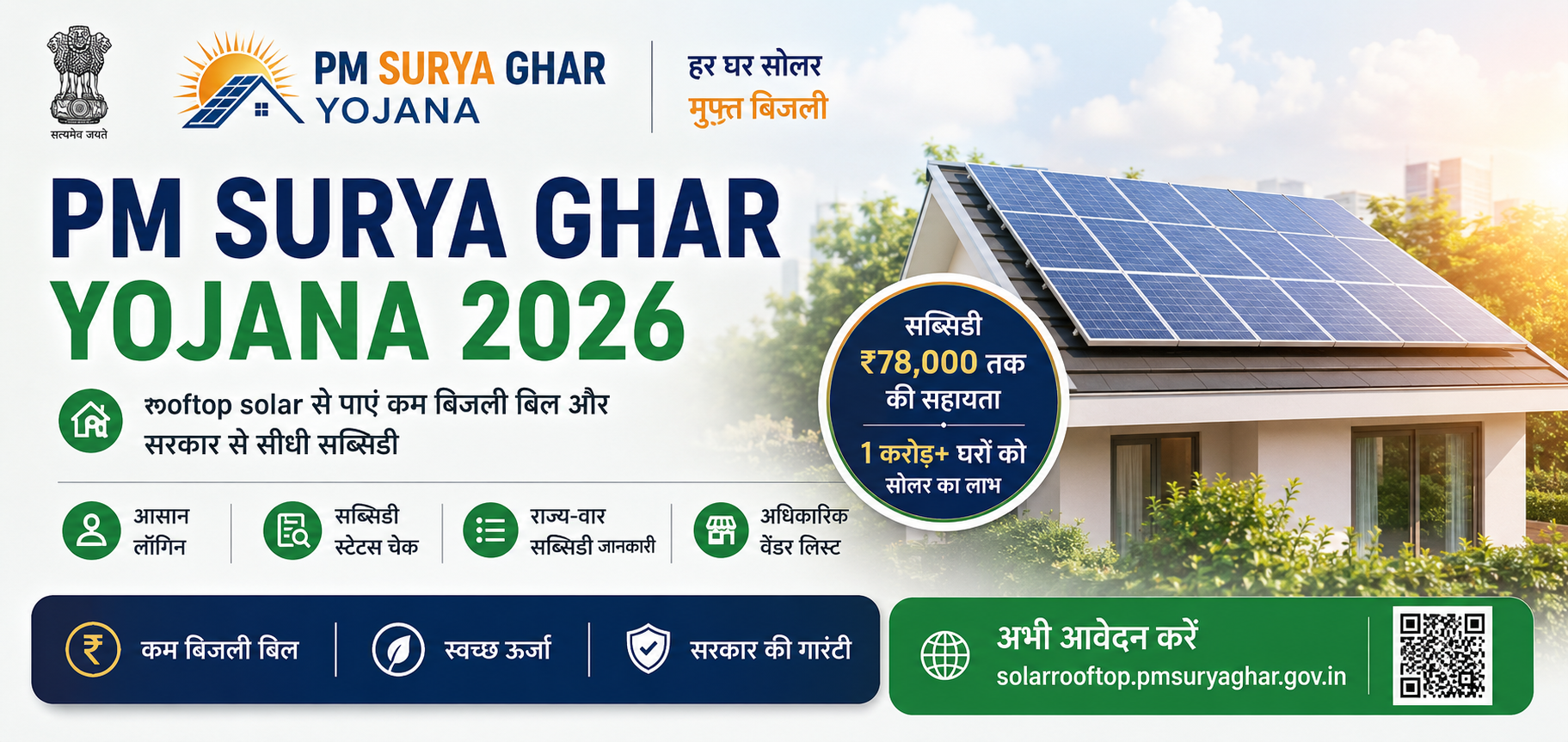
PM Surya Ghar Yojana 2026: Login, Subsidy Status & Vendor List
PM Surya Ghar Yojana continues to be one of India's most searched government schemes in 2026, targeting more than 1 crore rooftop solar installations by 2027.
The scheme helps households install rooftop solar systems with government subsidy support, lower electricity bills and long-term energy savings.
While many guides only explain subsidy amounts, applicants usually struggle with practical issues like:
What This Guide Covers
This 2026 guide explains how to register, log in, track subsidy payments, select official vendors, monitor rooftop solar approvals and avoid common mistakes during the process.
What Is PM Surya Ghar: Muft Bijli Yojana?
PM Surya Ghar: Muft Bijli Yojana is a Central Financial Assistance (CFA) scheme operated by the Ministry of New and Renewable Energy (MNRE).
The scheme was officially launched on 13 February 2024 with a total budget allocation exceeding ₹75,000 crore.
Rooftop Solar Mission
The scheme aims to install rooftop solar systems across 1 crore Indian households by 2027.
Free Electricity Benefit
Eligible households can receive up to 300 units of free electricity every month through rooftop solar generation.
Government Subsidy Support
The government provides Central Financial Assistance (CFA) to reduce rooftop solar installation costs.
How the Scheme Works
PM Surya Ghar operates through coordination between the national portal, state DISCOMs and approved solar vendors.
MNRE (National Portal)
- Application submission
- Subsidy tracking
- Subsidy disbursement
- Central portal management
DISCOM
- Feasibility approval
- Net metering approval
- Site inspection
- Grid connection verification
Empanelled Vendor
- Solar system installation
- Equipment supply
- Commissioning support
- Technical servicing
PM Surya Ghar Consumer Login Steps
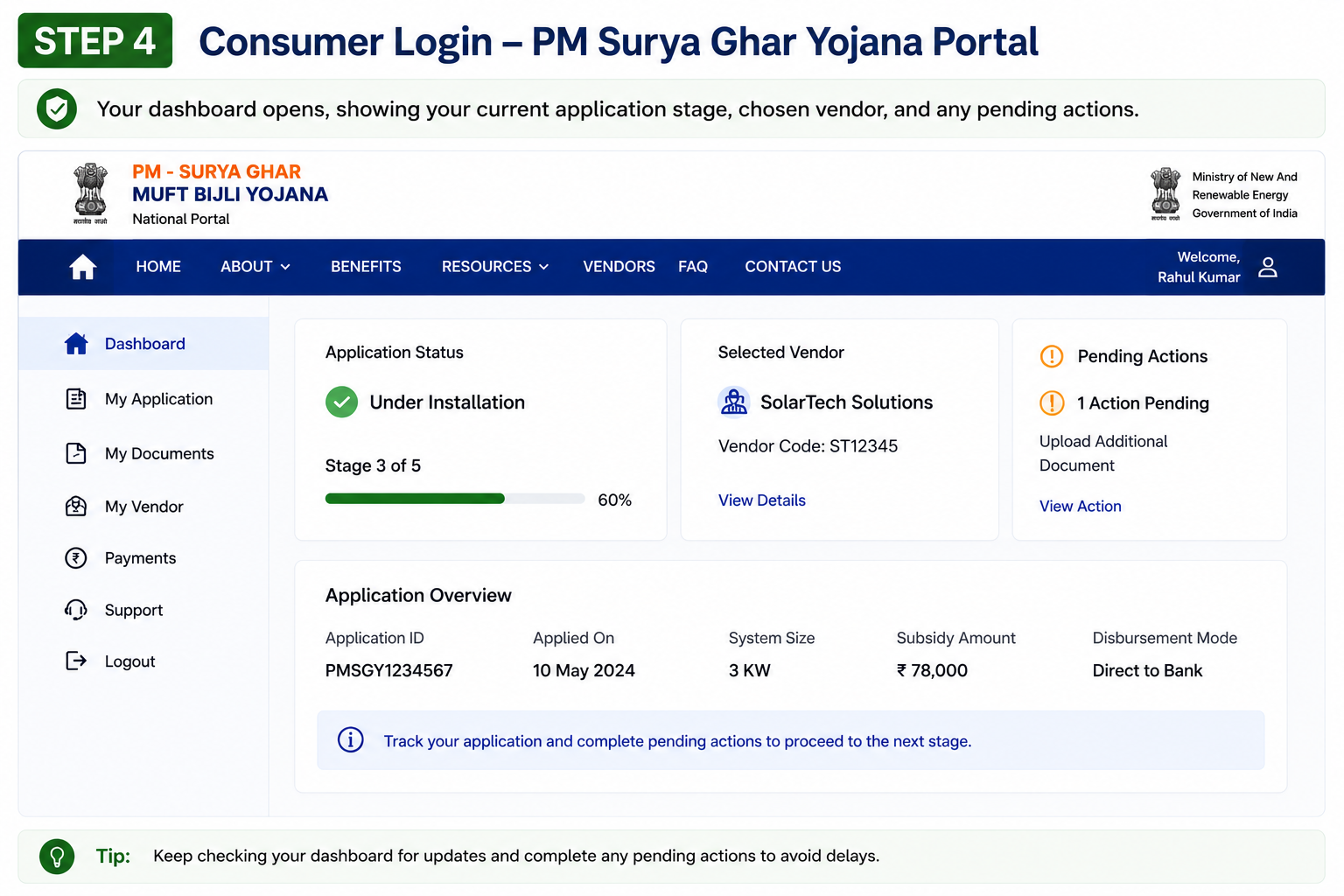
Homeowners can access their PM Surya Ghar dashboard using their registered mobile number and electricity consumer account details.
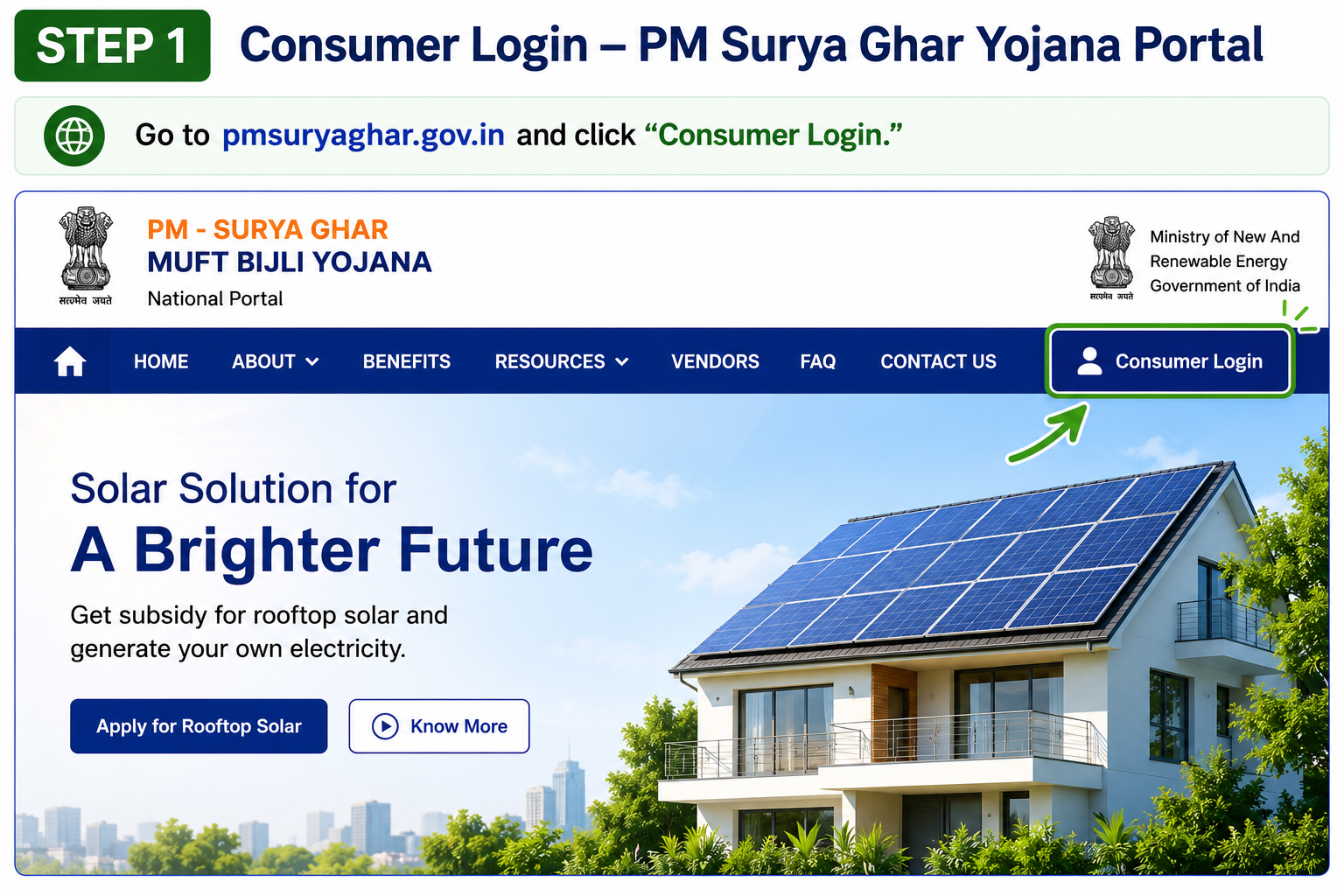
Enter Mobile Number & Consumer ID
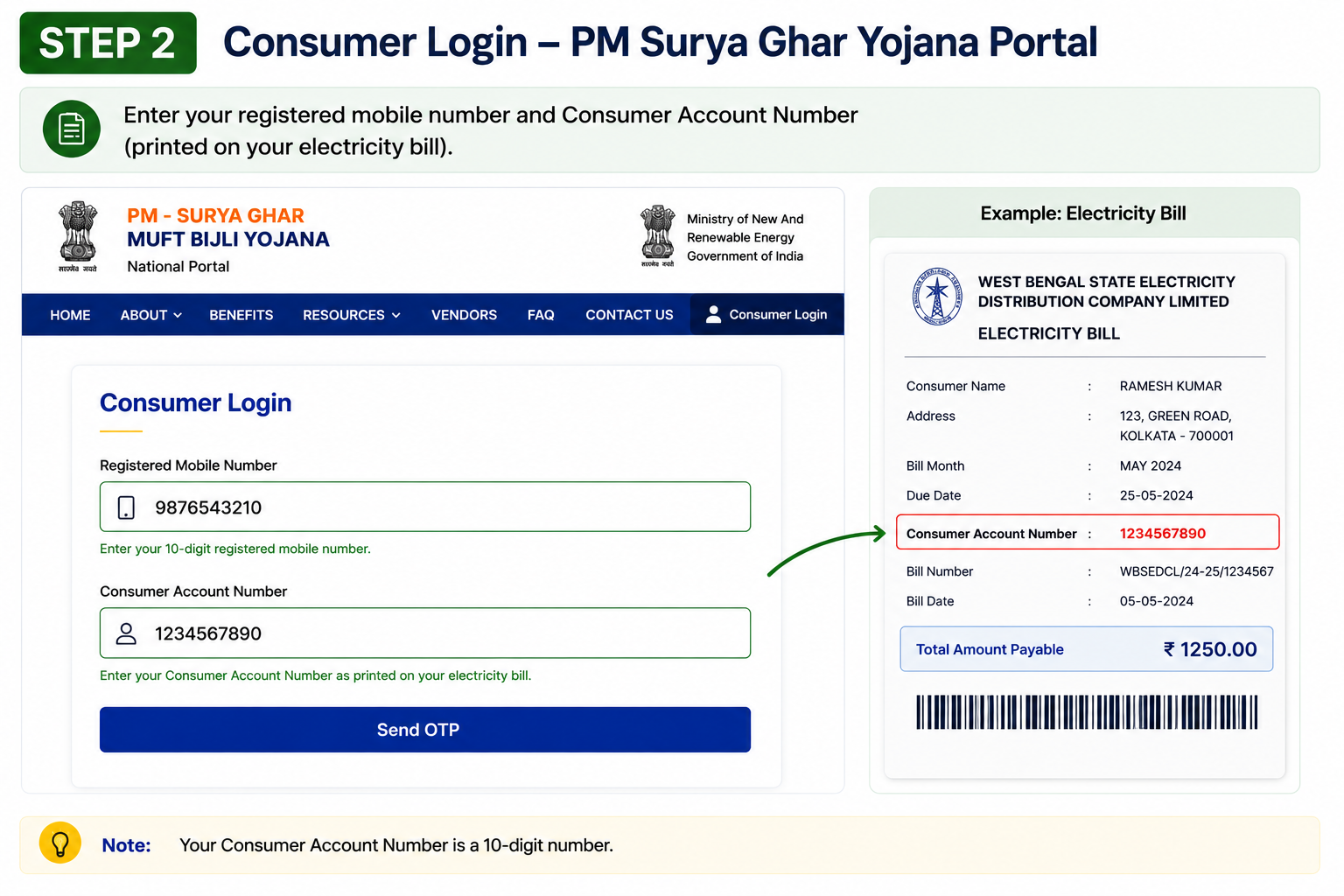
Enter your registered mobile number along with the Consumer Account Number printed on your electricity bill.
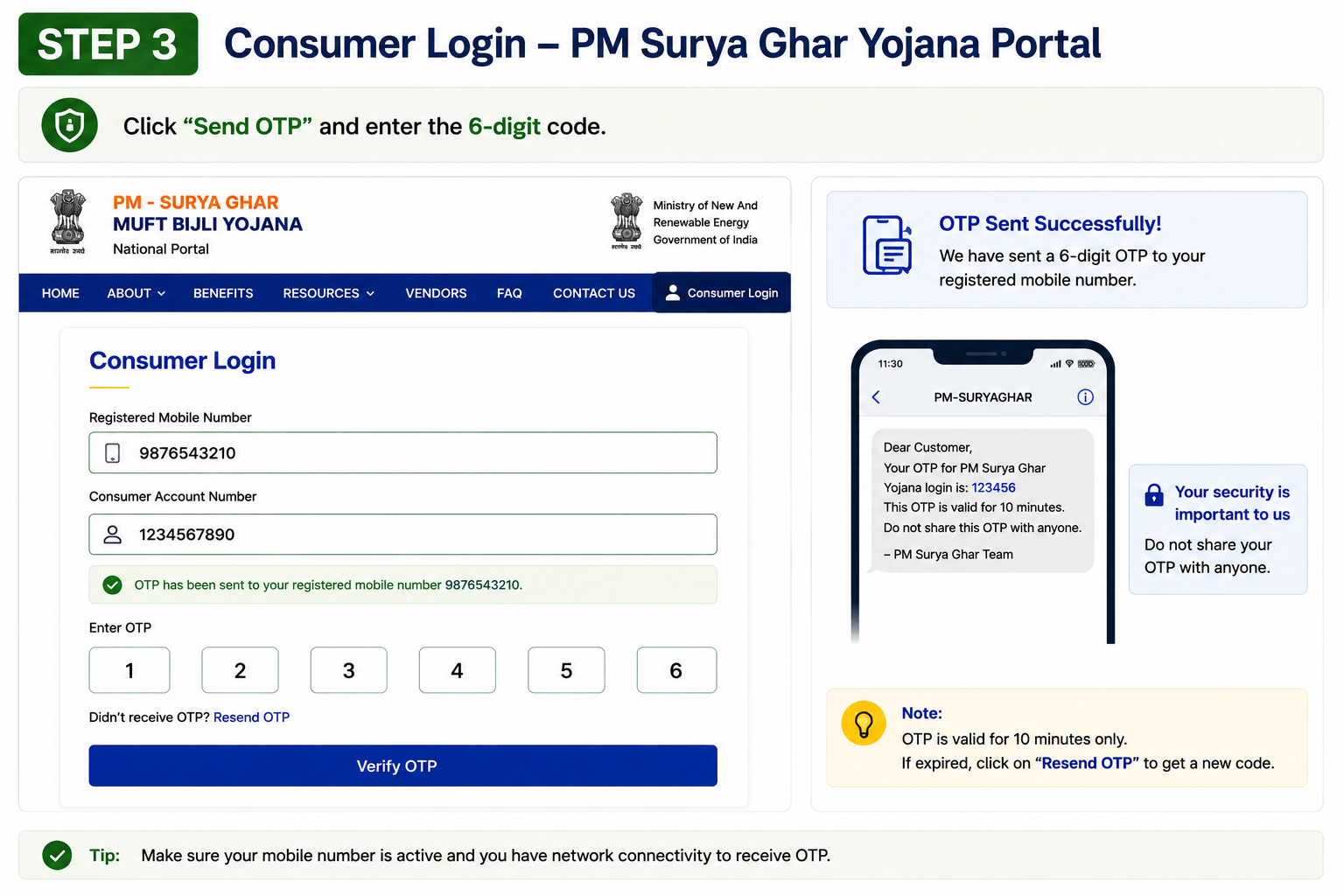
Verify OTP
Click "Send OTP" and enter the 6-digit verification code received on your mobile.
Access Dashboard
After login, your dashboard will display:
- Current application stage
- Selected vendor details
- Pending approvals or actions
- Subsidy and installation status
OTP & Mobile App Tips
If OTP delivery fails through SMS, the government's Sandes app can work as a backup notification channel.
A PM Surya Ghar mobile app is also available on the Play Store and usually maintains login sessions more reliably than the browser version.
How to Check PM Surya Ghar Subsidy Status (With and Without Login)
One of the most searched PM Surya Ghar topics in 2026 is subsidy tracking, especially when installation is complete but the subsidy amount hasn't appeared in the bank account yet.
Check Status Through Consumer Dashboard
Sign in to your PM Surya Ghar consumer account to view real-time subsidy and installation updates.
Track Using Application Number
Even without dashboard access, applicants can track status using only their application number on the portal's public tracking page.
What "Pending" Actually Means
A pending application status does not mean rejection.
Most delays happen because:
- DISCOM technical clearance is incomplete
- Grid compatibility checks are pending
- Vendor-side commissioning hasn't finished
- Net meter approval is still under review
When Subsidy Is "Disbursement Initiated"
If your dashboard shows "Disbursement Initiated", it means MNRE has already triggered the Direct Benefit Transfer (DBT).
The subsidy amount is normally credited within 3–7 working days depending on bank-side processing speed.
Realistic 2026 Subsidy Timelines (State by State)
The official government benchmark says subsidy payment should be credited within 30 working days after commissioning approval.
In reality, timelines vary significantly depending on your state, DISCOM efficiency, vendor responsiveness and local inspection workload.
| Stage | Typical Time |
|---|---|
| Registration to DISCOM feasibility approval |
3–15 working days
Faster in Gujarat & Delhi, slower in UP & MP |
| Installation (Vendor-dependent) |
Depends on vendor turnaround
Faster with experienced empanelled vendors |
| Net metering approval | 20–30 days after installation |
| Commissioning certificate to subsidy credit |
30 working days
Official MNRE benchmark |
Best-Performing States (2026)
These states currently have some of the fastest PM Surya Ghar processing cycles.
- Faster DISCOM approvals
- Better vendor response times
- Quicker subsidy disbursement
- Typical end-to-end timeline: 6–8 weeks
Slower Processing Circles
Applicants in these states are generally seeing longer wait times due to higher application volumes and slower approval cycles.
- Delayed feasibility approvals
- Longer inspection queues
- Slower net metering processing
- Realistic timeline: 3–5 months
Important Clarification
The government's "30 working day" promise applies only to the final subsidy disbursement stage after commissioning approval — not the complete rooftop solar journey.
In most North Indian states, applicants should realistically budget around 3–4 months total from registration to final subsidy credit.
State-Wise Subsidy: What the Central Scheme Doesn't Tell You
Most applicants only know about the central PM Surya Ghar subsidy range of ₹30,000–₹78,000.
What many homeowners miss is that several Indian states offer additional top-up subsidies beyond the central CFA amount.
In 2026, thousands of applicants still fail to claim these extra benefits simply because state-level schemes are poorly publicised.
| State | Additional Benefit |
|---|---|
| Rajasthan | Extra state top-up of roughly ₹17,000 through RREC, in addition to the central CFA. |
| Uttar Pradesh | Additional subsidy support processed through UPNEDA / UPPCL alongside the central subsidy. |
| Haryana | Active state-level rooftop solar subsidy top-up scheme. |
| Gujarat, Maharashtra, Tamil Nadu, Kerala, Karnataka & Delhi | Additional state top-up benefits beyond the central ₹78,000 subsidy cap. |
| Special Category States | Assam, Meghalaya, Manipur, Himachal Pradesh, Uttarakhand, Jammu & Kashmir, North-Eastern, hill and island regions receive an additional 10% subsidy per kW plus higher MNRE benchmark costs. |
Special Category States
Hill states, North-Eastern states and island territories receive additional support because:
- Installation costs are higher
- Transportation is more difficult
- Grid infrastructure varies widely
- Rooftop solar adoption needs extra incentives
States Without Confirmed Top-Up (2026)
As of 2026, Odisha and Chhattisgarh continue to follow the standard central subsidy structure.
Applicants should still confirm directly with their local DISCOM, since fiscal-year subsidy announcements can change unexpectedly.
Why State Subsidies Matter
State-level top-up subsidies can reduce the final rooftop solar installation cost far more than applicants expect.
In some states, combining central CFA with local incentives can significantly improve the rooftop solar payback period.
PM Surya Ghar Price List 2026: What You Actually Pay
One of the biggest misconceptions about PM Surya Ghar Yojana is that the government covers the full cost of rooftop solar installation.
In reality, the subsidy reduces the total expense, but homeowners still pay the remaining balance depending on system size and vendor pricing.
| System Size | Central Subsidy | Approx. System Cost | Approx. Net Cost After Subsidy |
|---|---|---|---|
| 1 kW | ₹30,000 | Vendor-dependent | Vendor-dependent |
| 2 kW | ₹60,000 | Vendor-dependent | Vendor-dependent |
| 3 kW |
₹78,000
Maximum subsidy cap |
~₹1,96,000 | ~₹1,18,000 |
| Above 3 kW |
₹78,000
Subsidy cap does not increase |
Depends on capacity | Depends on capacity |
Important Subsidy Rule Most Applicants Miss
The ₹78,000 subsidy limit stops at 3 kW.
Even if you install a 5 kW or 10 kW system, the central subsidy amount does not increase beyond the 3 kW cap.
That means you should size your solar system based on your actual electricity consumption, not simply to chase the highest subsidy amount.
EMI / Solar Loan Route Under PM Surya Ghar
Multiple public-sector banks now offer rooftop solar financing under the scheme.
Loan Features
- Loan amount up to ₹6 lakh
- Tenure up to 10 years
- Approx. interest rates: 5.75% – 10.15%
- Systems up to 3 kW qualify for collateral-free loans up to ₹2 lakh
Jansamarth Portal
Solar loans can be applied for through the Jansamarth portal in a single-window process.
Documentation and bank selection happen digitally through the portal.
Realistic EMI Example
On a 3 kW system's approximate net cost, a 5-year solar loan EMI typically works out to around ₹2,400–₹2,500/month.
For many households, this monthly EMI is often lower than the electricity bill the rooftop solar system replaces.
Finding an Empanelled Vendor (Vendor List)
One of the biggest reasons PM Surya Ghar subsidy applications get rejected is selecting a non-empanelled solar installer.
If the vendor is not officially approved, the subsidy becomes invalid and the property may permanently lose eligibility for reapplication.
Login to Consumer Dashboard
Open pmsuryaghar.gov.in and sign in to your consumer dashboard.
Use District Filter
Use the 2026 district-wise vendor filter to search approved vendors by:
- State
- DISCOM
- District
Verify Empanelment Status
Always cross-check the vendor's empanelment status directly on the official portal before signing any agreement.
Why Vendor Verification Matters
Installing rooftop solar through a non-empanelled installer can completely void the subsidy.
In many cases, applicants discover the issue only after installation is finished — when subsidy processing gets rejected during DISCOM or MNRE verification.
One-Time-Only Subsidy Rule Most Applicants Don't Know
The PM Surya Ghar subsidy is linked to the electricity consumer number, not to the person or household.
This means if a property owner already claimed the subsidy on a connection, the next owner cannot apply again using the same electricity account.
Even after property sale or ownership transfer, the connection remains permanently marked as subsidy-used in the system.
Smart Applicant Practice
- Compare multiple empanelled vendors
- Ask for past installation references
- Verify warranty details in writing
- Confirm net metering support beforehand
Common Mistakes in 2026
- Choosing the cheapest vendor blindly
- Paying full amount upfront
- Skipping empanelment verification
- Assuming every solar company qualifies
What's New on the PM Surya Ghar Portal in 2026
The PM Surya Ghar portal faced major reliability problems during its early rollout in 2024 — including failed OTP logins, poor tracking visibility, and frequent session crashes.
By 2026, most of those issues have been significantly improved, making the application and subsidy process far smoother for applicants and vendors.
Real-Time Status Tracking
Applicants can now track all six processing stages instead of seeing only "Applied" or "Approved."
More Stable OTP Login
Aadhaar-linked OTP failures, login session crashes, and repeated timeout issues have mostly been resolved.
Better Document Upload Support
The portal now accepts both:
- PDF files
- JPEG image uploads
File-size limits are now displayed clearly before upload starts.
District-Wise Vendor Filter
Applicants can now search empanelled vendors by:
- State
- DISCOM
- District
This makes local vendor selection much faster and safer.
Status Tracking Without Login
Applicants can now track application progress using only the application number, without signing into the dashboard.
Vendor Face Authentication
Some DISCOMs now require vendors handling high-capacity installations to complete a one-time biometric or face verification.
This was introduced to reduce fake commissioning claims.
Earlier Portal Problems
- Frequent crashes
- Failed OTP delivery
- No meaningful status tracking
- Upload failures during peak traffic
- Session timeouts during payment
Current Portal Improvements
- More reliable login system
- Faster application tracking
- Better document upload flow
- Public tracking without login
- Improved vendor verification
Important Applicant Tip
Even though the portal is far more stable in 2026, users still experience slower performance during high-traffic periods — especially near subsidy deadlines or state DISCOM rollout phases.
If Your Subsidy Is Delayed: Escalation Path
If your PM Surya Ghar subsidy has not arrived even 90 days after commissioning, don't immediately assume the subsidy was rejected.
In most 2026 cases, delays happen because of:
- Bank-account name mismatch
- Pending DISCOM sign-off
- Net-metering verification delays
- Incomplete commissioning data upload
File a Written DISCOM Grievance
Contact your DISCOM's consumer grievance cell first.
Ask them to verify:
- Net-meter approval status
- Bank account verification
- Commissioning sign-off completion
Contact MNRE Helpline
If DISCOM follow-up doesn't help, escalate directly through the national scheme helplines.
Contact State Renewable Agency
Escalate to your state nodal renewable energy agency.
- UPNEDA (Uttar Pradesh)
- RREC (Rajasthan)
- Other state renewable agencies
These agencies coordinate directly with DISCOMs and MNRE.
File Complaint on CPGRAMS
If your issue remains unresolved, escalate through:
This creates an official government-tracked grievance.
File an RTI Application
If delays still continue, file an RTI under Section 6(1) of the RTI Act, 2005.
Specifically ask for:
Realistic Delay Expectations in 2026
In slower DISCOM circles, subsidy delays beyond 90 days are unfortunately still common — especially in high-volume states.
The key is escalating in the correct order while keeping all:
- Payment receipts
- Commissioning reports
- Vendor invoices
- Net-meter approval copies
safely stored for reference.
Common Rejection Reasons and Quick Fixes
A large number of PM Surya Ghar applications in 2026 are delayed or rejected because of small technical or documentation mistakes — many of which can be fixed quickly if identified early.
Most rejections are not permanent; they usually happen because the application failed a verification checkpoint.
| Rejection Reason | Quick Fix |
|---|---|
| Commercial or agricultural electricity category | Verify that your electricity bill shows "Domestic" or "LT-1 Residential". If incorrect, request category correction from your DISCOM before applying. |
| Blurry or incomplete document uploads | Scan documents at minimum 200 DPI, keep file size under 2 MB, and upload in PDF or JPEG format. |
| Bank account not Aadhaar-linked | Link your bank account with Aadhaar before applying. DBT subsidy transfer will fail otherwise. |
| Non-empanelled vendor selected | Always cross-check vendor empanelment through the portal's district-wise vendor filter before signing any agreement. |
| Consumer number already used for an earlier subsidy claim | PM Surya Ghar subsidy works on a one-time-per-connection basis. A second claim on the same electricity consumer number will be rejected. |
Most Frequent Problem in 2026
The single biggest issue applicants still face is uploading:
- Cropped documents
- Blurry electricity bills
- Unclear Aadhaar scans
- Wrong bank account details
DBT & Bank Verification Issues
Many applicants assume that entering a bank account number is enough.
In reality, the subsidy transfer depends on:
- Aadhaar-bank linking
- Exact name matching
- Correct IFSC details
- Active DBT-enabled account status
Best Way to Avoid Rejection
Before submitting the application:
- Verify your electricity category
- Re-check bank details carefully
- Upload clear scanned documents
- Confirm vendor empanelment status
- Match names exactly across all records
Spending 10 extra minutes on verification can save weeks of subsidy delays later.
Common Rejection Reasons and Quick Fixes
A large number of PM Surya Ghar applications in 2026 are delayed or rejected because of small technical or documentation mistakes — many of which can be fixed quickly if identified early.
Most rejections are not permanent; they usually happen because the application failed a verification checkpoint.
| Rejection Reason | Quick Fix |
|---|---|
| Commercial or agricultural electricity category | Verify that your electricity bill shows "Domestic" or "LT-1 Residential". If incorrect, request category correction from your DISCOM before applying. |
| Blurry or incomplete document uploads | Scan documents at minimum 200 DPI, keep file size under 2 MB, and upload in PDF or JPEG format. |
| Bank account not Aadhaar-linked | Link your bank account with Aadhaar before applying. DBT subsidy transfer will fail otherwise. |
| Non-empanelled vendor selected | Always cross-check vendor empanelment through the portal's district-wise vendor filter before signing any agreement. |
| Consumer number already used for an earlier subsidy claim | PM Surya Ghar subsidy works on a one-time-per-connection basis. A second claim on the same electricity consumer number will be rejected. |
Most Frequent Problem in 2026
The single biggest issue applicants still face is uploading:
- Cropped documents
- Blurry electricity bills
- Unclear Aadhaar scans
- Wrong bank account details
DBT & Bank Verification Issues
Many applicants assume that entering a bank account number is enough.
In reality, the subsidy transfer depends on:
- Aadhaar-bank linking
- Exact name matching
- Correct IFSC details
- Active DBT-enabled account status
Best Way to Avoid Rejection
Before submitting the application:
- Verify your electricity category
- Re-check bank details carefully
- Upload clear scanned documents
- Confirm vendor empanelment status
- Match names exactly across all records
Spending 10 extra minutes on verification can save weeks of subsidy delays later.
PM Surya Ghar Yojana in Current Affairs / UPSC Context
PM Surya Ghar Yojana has become an important governance, renewable energy and public-policy topic for UPSC, State PCS and current-affairs preparation.
The scheme is frequently discussed because of its scale, subsidy model, and its role in India's clean-energy transition.
World's Largest Rooftop Solar CFA Programme
PM Surya Ghar is widely referenced as one of the world's largest rooftop-solar Central Financial Assistance (CFA) programmes.
DBT-Based Subsidy Model
The scheme uses Direct Benefit Transfer (DBT) for subsidy payments, reducing middlemen and improving transparency.
- Subsidy credited directly to bank accounts
- Aadhaar-linked verification
- Digital application tracking
Renewable Energy & Net-Zero Goals
PM Surya Ghar supports India's:
- Renewable energy expansion
- Distributed solar generation
- Net-zero emissions commitments
- Reduction in fossil-fuel dependency
Centre–State Coordination Model
The scheme is administered jointly by:
This makes it a strong example of cooperative federalism in public administration answers.
Important Governance Angle (2026)
During the scheme's second full operational year, government monitoring expanded to include performance-based notices for states with slow subsidy disbursement.
This point is particularly useful in governance, accountability, public-service delivery, and digital-administration answers.
Key Themes Candidates Can Mention
Exam-Relevant Observation
PM Surya Ghar is not just a subsidy programme — it is increasingly being studied as a case example of large-scale digital public-service delivery linked with climate policy and energy security.
Quick Reference
A fast-reference summary of the most important PM Surya Ghar Yojana details, including subsidy structure, portal logins, helpline numbers, and official timelines.
| Particular | Detail |
|---|---|
| Launch Date | 13 February 2024 |
| Nodal Ministry | Ministry of New and Renewable Energy (MNRE) |
| Subsidy Range | ₹30,000 (1 kW) – ₹78,000 (3 kW and above, capped) |
| Free Electricity Benefit | Up to 300 units per month |
| Official Portal | pmsuryaghar.gov.in |
| Consumer Login | consumer.pmsuryaghar.gov.in |
| Vendor Login | vendor.pmsuryaghar.gov.in |
| DISCOM Login | discom.pmsuryaghar.gov.in/discom/ |
| Helpline Numbers | 15555 / 1800-180-3333 |
| Official Subsidy Benchmark | 30 working days from commissioning certificate |
What This Guide Covers
This guide explains:
- PM Surya Ghar portal login system
- Subsidy tracking process
- State-wise subsidy top-ups
- Vendor verification rules
- Escalation steps for delayed subsidy
- Common rejection reasons and fixes
Important Disclaimer
Scheme rules, subsidy amounts, vendor policies, state-level top-ups, and portal features may change over time.
Always cross-check the latest updates directly on the official PM Surya Ghar portal before applying or making payments.

Isaac Murphy
Writer & Solar Scheme ResearcherIsaac Murphy writes for PM Surya Ghar.info, a site that helps people make sense of India's rooftop solar scheme. From checking subsidy status to finding approved vendors and avoiding delays, he breaks down official jargon into plain, useful advice. When he's not writing, he's likely tracking the latest portal updates and state policy changes.